Learning Mandarin Chinese pronunciation can feel intimidating. Between tricky vowel sounds, entirely new consonants, and the famous tone system, it’s easy to get overwhelmed. But getting as close to a native speaker as possible is entirely doable when you break it down into core concepts. This guide will walk you through the absolute essentials of Mandarin pronunciation.
Why Pinyin is your set of training wheels
Mandarin’s written form relies on Chinese characters. While these characters are beautiful, they don’t give you obvious clues on how to pronounce them. If you’re just starting out, reading a character out loud is practically a guessing game.
That’s where Pinyin comes in. Think of Pinyin as the stabilizers on a kid’s bike. It uses Romanized letters to represent Chinese sounds. This helps you get moving immediately.
A standard Pinyin syllable is made of two parts. You have an initial, which is like a consonant. Then you have a final, which acts like a vowel. For example, in the word wēn, w is the initial and en is the final.
But there’s a catch. Because Pinyin looks just like English, it’s tempting to read it like English. Don’t fall into this trap. A ch in Pinyin sounds completely different from a ch in English. You have to learn the specific sounds these letters represent in Mandarin.
It’s also crucial to remember that Pinyin is just a tool. A single Pinyin sound like wēn can mean “warm”, “temperature”, or even “sardine” depending on the character it represents. Use Pinyin to find your balance, but don’t rely on it forever.
The four main tones (and why they matter)
In Mandarin, changing your pitch changes the entire meaning of a word. The language features four main tones. Let’s look at that wen example again:
wēn(First tone)wén(Second tone)wěn(Third tone)wèn(Fourth tone)
That’s four different pitches. They mean four completely different things. Getting these right is the secret to actually being understood by native speakers.
Nailing the first tone
The first tone is a high, flat, and sustained sound. The best way to practice this is to literally sing it. If you try to just “say” it, your voice will naturally drop or rise based on your native language’s speaking habits.
When you say words like chī (eat), hē (drink), or tīng (listen), hold the pitch steady from start to finish.
A great trick is to sustain the sound longer than you think you need to. Every syllable in Chinese should be held slightly longer unless it’s a specific “neutral” tone.
If you’re pronouncing a diphthong, which is two vowel sounds together like āi, lengthen the main vowel. Hold the a for a long time, and then quickly close it off with the i at the very end. Don’t break it into two separate syllables like “ah-ee”. Keep it as one continuous, singing sound.
Conquering the second tone
The second tone is a rising sound. It’s a doubling pitch that starts lower and moves higher. Think of it exactly like a crescendo in music.
You need to hit two distinct pitches to make this sound correctly. It works like a grace note. Your starting pitch is roughly at the same high level as your first tone, but then you push it even higher.
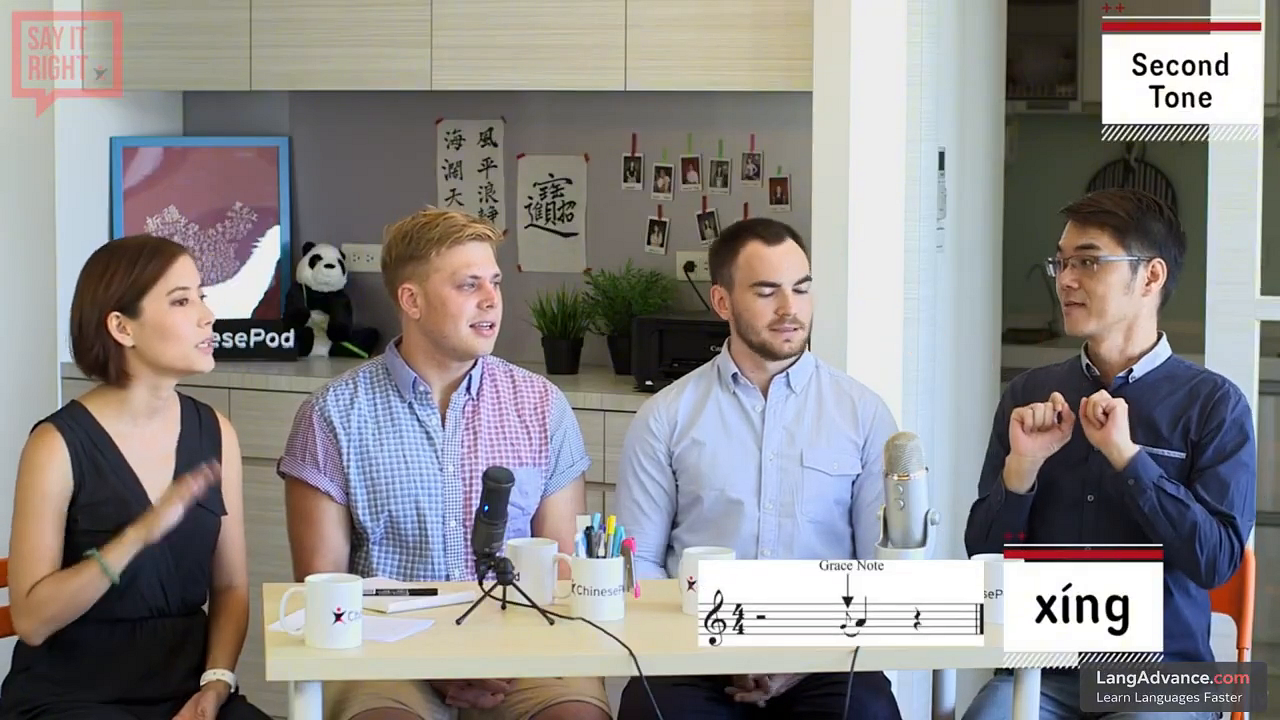
Try saying xíng. Start high, and slide the pitch up. A common mistake is starting way too low. This accidentally makes it sound like a third tone, which is a creaky, lower sound. Keep your starting pitch relatively high, and end on an even higher note. Practice this with a word like qíng tiān (sunny day) to feel the rise.
Key takeaways for practicing
Getting your mouth and vocal cords used to these new rules takes time. Keep these tips in your back pocket:
- Sing the first tone. Keep it flat, high, and long.
- Slide the second tone. Start high and go higher.
- Don’t trust your English brain. Pinyin letters don’t make English sounds.
- Batch your practice. Watch your Main Lecture videos to understand the theory. Then immediately use Drill videos to build muscle memory.
- Ask for help. If you get stuck on a sound, drop a question in the Discussion forum.
Ready to sound like a native?
Pronunciation isn’t just about being understood. It’s about building a strong, confident foundation for your entire Mandarin journey. Take it at your own pace, pause and rewind when you hit a tricky sound, and don’t be afraid to exaggerate the tones while you practice. With a bit of repetition, those strange new sounds will become second nature.
Steps tested on the current version at the time of writing. If a screen or setting has moved, email us and we update the tutorial. Results depend on your offer and your market; nothing here is a promise of income.