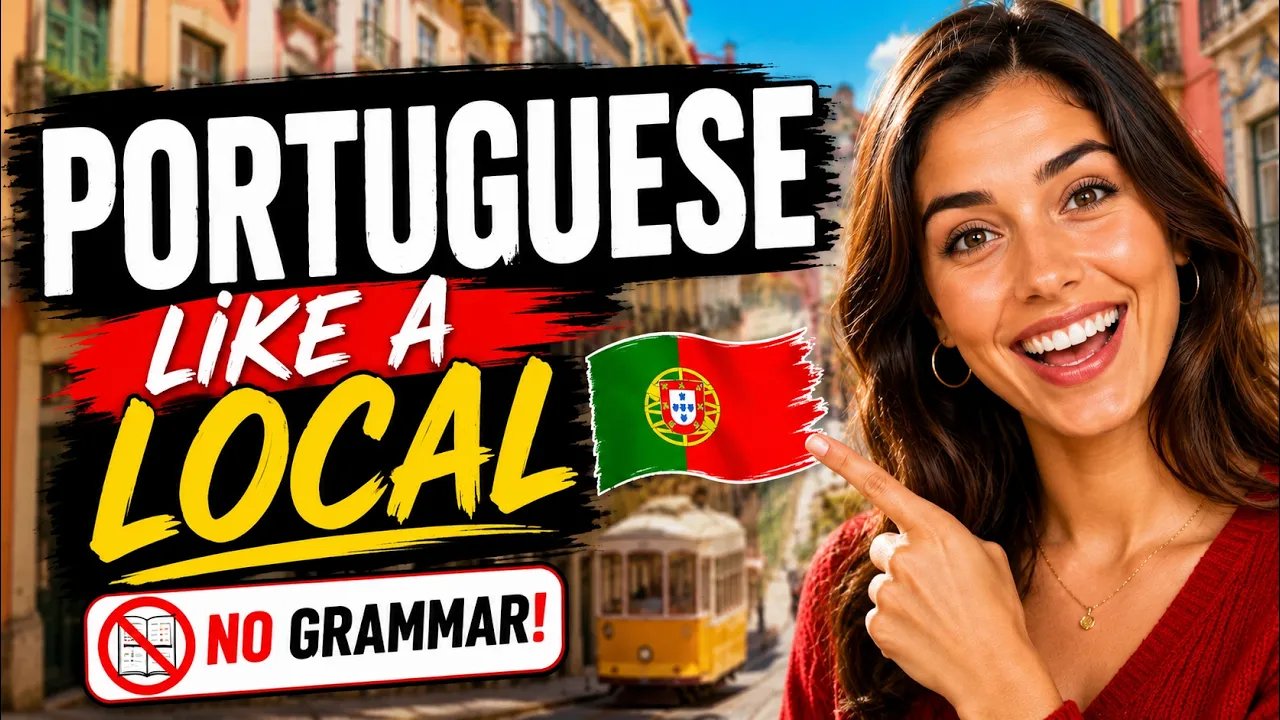
Learning Portuguese doesn’t have to be complicated. Many beginners spend months studying grammar rules but still struggle to hold a simple conversation. The secret to success is focusing on practical Portuguese phrases and real-life communication from day one.
This beginner-friendly guide introduces essential European Portuguese expressions, greetings, introductions, numbers, shopping vocabulary, and travel phrases that will help you communicate naturally and confidently in Portugal.
🚀 Learn Portuguese FAST — Start Free Today 🎯
Why Learn Portuguese?
Portuguese is spoken by more than 260 million people worldwide and is one of the fastest-growing global languages. Whether you’re traveling to Portugal, planning to relocate, doing business, or simply exploring a new culture, learning Portuguese opens the door to meaningful connections and unforgettable experiences.
The goal is not perfection. The goal is communication.
Essential Portuguese Greetings
Greetings are the foundation of every conversation. Learning these basic Portuguese phrases will help you make a positive first impression.
Saying Hello
Olá – Hello
Bom dia – Good morning
Boa tarde – Good afternoon
Boa noite – Good evening / Good night
These expressions are used daily throughout Portugal and are among the most important Portuguese words for beginners.
How to Say Goodbye in Portuguese
When ending a conversation, you’ll frequently hear these expressions:
Common Farewells
Adeus – Goodbye
Tchau – Bye
Até logo – See you later
Até já – See you soon
Até amanhã – See you tomorrow
While “Adeus” is more formal, “Tchau” is widely used in casual conversations among friends and family.
Saying Thank You and You’re Welcome
Politeness plays an important role in Portuguese culture.
Thank You
For men:
Obrigado
For women:
Obrigada
Thank You Very Much
Muito obrigado
Muito obrigada
You’re Welcome
De nada
Using these expressions regularly helps you sound friendly and respectful.
Introducing Yourself in Portuguese
One of the first things you’ll do when meeting someone is introduce yourself.
Saying Your Name
O meu nome é…
(My name is…)
Example:
O meu nome é Maria.
A More Natural Alternative
Chamo-me…
(I call myself…)
Example:
Chamo-me João.
This form is especially common in European Portuguese.
Saying Where You’re From
Talking about your hometown or country is an important conversation skill.
Useful Phrase
Sou de…
(I am from…)
Example:
Sou de Londres.
(I am from London.)
Talking About Where You Live
Vivo em…
(I live in…)
Example:
Vivo em Lisboa.
(I live in Lisbon.)
How Are You? Essential Portuguese Conversation Starters
After greetings and introductions, the next step is learning how to ask and answer “How are you?”
Asking How Are You
Tudo bem?
(Everything good?)
Como está?
(How are you? – formal)
Como estás?
(How are you? – informal)
Common Responses
Tudo bem.
(Everything is fine.)
Mais ou menos.
(So-so.)
Estou bem. Obrigado.
(I am well. Thank you.)
Asking Back
E tu?
(And you? – informal)
E você?
(And you? – formal)
These phrases make it easy to begin natural conversations in Portuguese.
Important Polite Expressions
Learning polite language is essential when visiting Portugal.
Please
Por favor
Example:
Um café, por favor.
(A coffee, please.)
Excuse Me / Sorry
Desculpe
Example:
Desculpe, não percebi.
(Sorry, I didn’t understand.)
Excuse Me (Getting Attention)
Com licença
Useful when:
- Asking for directions
- Passing through a crowd
- Getting someone’s attention
What to Say When You Don’t Understand Portuguese
Every language learner experiences moments of confusion.
Fortunately, these simple Portuguese phrases help keep conversations moving.
Useful Survival Phrases
Não percebi.
(I didn’t understand.)
Não entendi.
(I didn’t get it.)
Não falo bem português.
(I don’t speak Portuguese well.)
O meu português não é muito bom.
(My Portuguese isn’t very good.)
Asking for Help
Pode repetir, por favor?
(Can you repeat, please?)
Pode falar mais devagar?
(Can you speak more slowly?)
Ainda estou a aprender.
(I am still learning.)
Portuguese speakers generally appreciate learners who make an effort and are often happy to help.
Portuguese Numbers for Everyday Situations
Numbers are essential for shopping, transportation, restaurants, and daily life.
Numbers 1–10
1 – Um
2 – Dois
3 – Três
4 – Quatro
5 – Cinco
6 – Seis
7 – Sete
8 – Oito
9 – Nove
10 – Dez
Larger Numbers
20 – Vinte
30 – Trinta
40 – Quarenta
50 – Cinquenta
100 – Cem
Mastering these numbers makes traveling in Portugal much easier.
Shopping and Asking Prices in Portuguese
Shopping is one of the most common situations travelers encounter.
Asking the Price
Quanto custa?
(How much does it cost?)
Talking About Price
É muito caro.
(It is very expensive.)
Tem algo mais barato?
(Do you have something cheaper?)
Paying
Aqui está.
(Here it is.)
Fique com o troco.
(Keep the change.)
Card Payments
Posso pagar com cartão?
(Can I pay by card?)
These practical phrases are useful in shops, restaurants, and markets.
Ordering Coffee Like a Local
Coffee culture is an important part of daily life in Portugal.
Simple Coffee Order
Um café, por favor.
(A coffee, please.)
More Polite Version
Queria um café, por favor.
(I would like a coffee, please.)
Example Conversation
Bom dia.
Good morning.
Um café, por favor.
A coffee, please.
Quanto custa?
How much does it cost?
Aqui está.
Here you are.
Obrigado.
Thank you.
Até logo.
See you later.
Asking for Directions in Portuguese
Getting around Portugal becomes much easier once you know these expressions.
Asking Where Something Is
Onde fica…?
(Where is…?)
Examples:
- Onde fica a estação?
- Onde fica o supermercado?
Direction Vocabulary
Esquerda – Left
Direita – Right
Em frente – Straight ahead
Perto – Near
Longe – Far
Transportation Vocabulary
Sinal – Traffic light
Rotunda – Roundabout
These words appear frequently when asking for directions.
Shopping Conversations in Portuguese
When shopping for clothes, gifts, or souvenirs, these phrases are extremely useful.
Expressing Preferences
Gosto deste.
(I like this one.)
Prefiro aquele.
(I prefer that one.)
Trying Things On
Posso experimentar?
(Can I try it on?)
Asking About Sizes and Colors
Tem outro tamanho?
(Do you have another size?)
Tem outra cor?
(Do you have another color?)
Asking for Assistance
Pode ajudar-me?
(Can you help me?)
Gift Wrapping
Pode embrulhar?
(Can you wrap it?)
Best Way to Learn Portuguese Faster
If you want to improve your Portuguese quickly:
Speak Out Loud
Practice every phrase aloud rather than only reading.
Use Portuguese Daily
Even short interactions build confidence.
Learn Useful Phrases First
Focus on communication before advanced grammar.
Repeat Real Conversations
Practice greetings, ordering coffee, shopping, and asking directions repeatedly.
Don’t Fear Mistakes
Making mistakes is a natural part of language learning.
🚀 Learn Portuguese FAST — Start Free Today 🎯
Final Thoughts
Learning Portuguese becomes much easier when you focus on practical communication rather than memorizing endless grammar rules. By mastering greetings, introductions, polite expressions, numbers, shopping vocabulary, and travel phrases, you’ll quickly gain the confidence needed to interact with native speakers.
The most important step is simply starting. Speak often, practice daily, and remember that every conversation brings you closer to fluency in Portuguese.
Steps tested on the current version at the time of writing. If a screen or setting has moved, email us and we update the tutorial. Results depend on your offer and your market; nothing here is a promise of income.