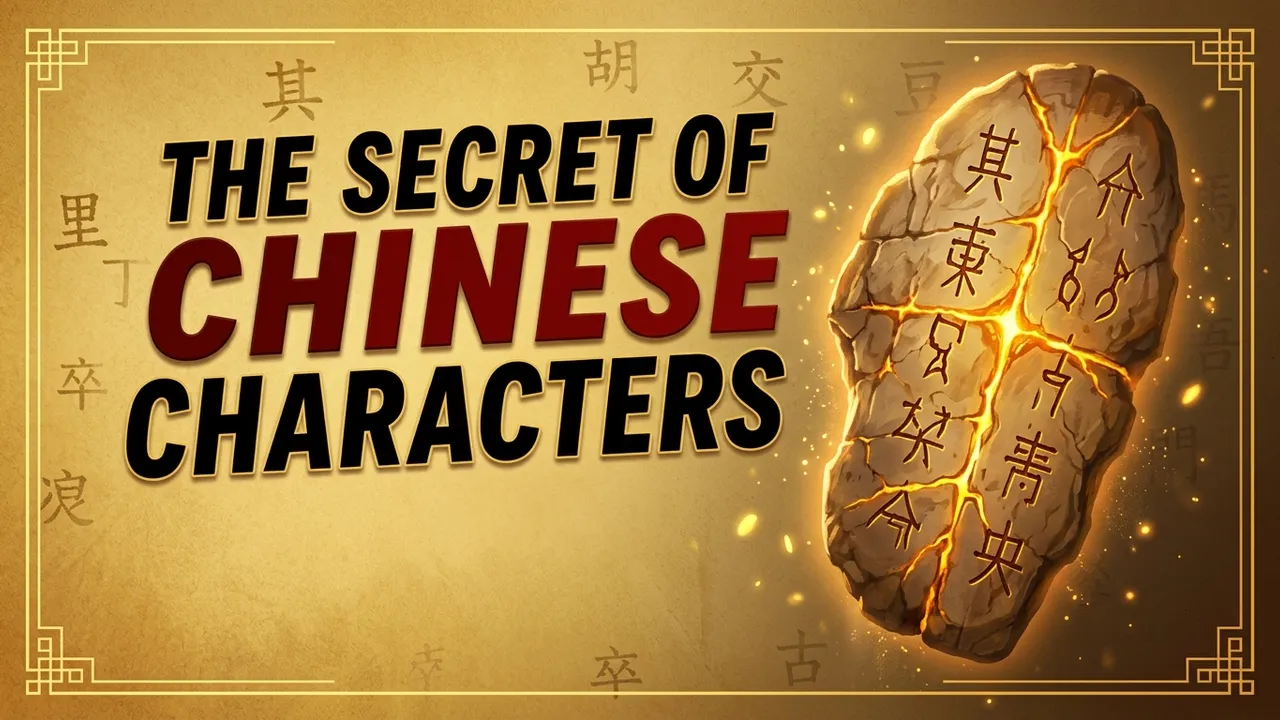
Chinese is one of the oldest continuously used writing systems in human history. While many language learners initially feel intimidated by Chinese characters, the truth is that the Chinese writing system follows logical patterns that become easier to understand once you learn how characters are created.
If you’ve ever wondered:
- How do Chinese characters work?
- What are Chinese radicals?
- What is Oracle Bone Script?
- Why do Chinese characters look so different from English letters?
- How can beginners learn Chinese characters faster?
This comprehensive guide will answer all of these questions and provide a structured roadmap for mastering Chinese writing.
Table of Contents
- What Are Chinese Characters?
- Why Learning Chinese Characters Is Easier Than You Think
- The History of Chinese Writing
- Oracle Bone Script: The Beginning of Chinese Characters
- The Six Principles of Chinese Character Creation
- Understanding Chinese Radicals
- The Wood Radical Family (木)
- The Fruit Character Family (果)
- Chinese Character Evolution Through Time
- Best Ways to Learn Chinese Characters Fast
- Recommended Resources
- Frequently Asked Questions
What Are Chinese Characters?
Chinese characters are logographic symbols used to represent words and meanings rather than individual sounds.
Unlike English:
| English | Chinese |
|---|---|
| Uses alphabet letters | Uses characters |
| Letters form words | Characters form words |
| 26 letters | Thousands of characters |
| Sound-based | Meaning-based |
Many beginners believe they must memorize tens of thousands of characters.
Fortunately, that is not true.
How Many Chinese Characters Do You Really Need?
| Level | Characters Needed |
|---|---|
| Basic Daily Life | 300–500 |
| Intermediate Reading | 1,500–2,000 |
| Newspapers | 3,000+ |
| Native-Level Literacy | 4,000–5,000 |
Most daily conversations can be handled with only a few hundred characters.
Why Learning Chinese Characters Is Easier Than You Think
One of the biggest myths about Mandarin Chinese is that the writing system is impossible to learn.
In reality:
- Characters follow patterns.
- Many share common components.
- Radicals provide meaning clues.
- Character families help memory.
Once you understand the building blocks, Chinese becomes much easier.
Think of Chinese characters as LEGO blocks.
Small pieces combine to create larger structures.
The History of Chinese Writing
Chinese writing has evolved for over 3,000 years.
Major Historical Stages
| Period | Writing Style |
|---|---|
| Oracle Bone Script | Earliest known form |
| Bronze Script | Engraved on bronze objects |
| Seal Script | Standardized writing |
| Clerical Script | Administrative writing |
| Regular Script | Modern Chinese writing |
Despite thousands of years of development, many modern characters still preserve traces of their original forms.
Oracle Bone Script: The Birth of Chinese Characters
Oracle Bone Script represents the earliest known Chinese writing system.
Ancient Chinese scholars carved symbols onto:
- Animal bones
- Turtle shells
These inscriptions were used for:
- Divination
- Government records
- Religious ceremonies
Many modern Chinese characters originated from simple drawings.
Example
The character 木 (tree) originally looked like a tree:
- Vertical line = trunk
- Horizontal lines = branches
This simple image eventually evolved into the modern character 木.
This demonstrates the beauty of Chinese writing:
Characters were originally pictures.
The Six Principles of Chinese Character Creation
Chinese linguistics identifies six major methods of character creation.
1. Pictographs (象形)
Characters created by drawing objects.
Examples:
| Character | Meaning |
|---|---|
| 木 | Tree |
| 人 | Person |
| 山 | Mountain |
2. Indicative Characters (指事)
Used to express abstract concepts.
Examples:
| Character | Meaning |
|---|---|
| 上 | Above |
| 下 | Below |
3. Associative Compounds (会意)
Created by combining multiple ideas.
Example:
休
Person + Tree
Meaning:
A person resting under a tree.
4. Phonetic Compounds (形声)
Most modern Chinese characters belong to this category.
One component indicates:
- Meaning
Another indicates:
- Pronunciation
Approximately 80% of modern Chinese characters use this system.
5. Loan Characters
Characters borrowed for different meanings.
6. Transferred Characters
Characters whose meanings evolved through usage.
Understanding Chinese Radicals
Radicals are the building blocks of Chinese characters.
Think of them as:
- Roots
- Clues
- Meaning indicators
Learning radicals dramatically accelerates character recognition.
Most Common Radicals
| Radical | Meaning |
|---|---|
| 木 | Wood |
| 水 | Water |
| 火 | Fire |
| 人 | Person |
| 心 | Heart |
| 口 | Mouth |
Once you know the radical, you often understand the general meaning of the character.
The Wood Radical Family (木)
One of the most fascinating character families is built around:
木 (Mù) – Tree
The original pictograph resembles a tree.
Meaning:
- Tree
- Wood
林 (Lín) – Woods
Two trees together:
木 + 木
Meaning:
Forest or woods.
Memory Trick
Two trees standing together create a small forest.
森 (Sēn) – Forest
Three trees together:
木 + 木 + 木
Meaning:
Dense forest.
Memory Trick
More trees = bigger forest.
本 (Běn) – Root
A line placed beneath the tree indicates:
Root.
Meaning:
Origin, foundation.
末 (Mò) – Tip
A line placed at the top indicates:
Tree top.
Meaning:
End, tip, final.
The Fruit Character Family (果)
Another important character family centers around:
果 (Guǒ)
Meaning:
Fruit
Originally represented fruit growing on a tree.
Cultural Meaning of 果
Chinese culture extends the meaning of fruit to:
- Results
- Outcomes
- Achievements
Examples:
成果
Achievement
结果
Result
This demonstrates how Chinese characters evolve from concrete images into abstract concepts.
Why Character Families Matter
Character families help learners:
- Recognize patterns
- Learn faster
- Memorize efficiently
Instead of learning 1000 isolated characters, you learn groups connected through shared roots.
How Chinese Characters Reflect Chinese Culture
Chinese characters are not random symbols.
They preserve:
- Ancient lifestyles
- Agriculture
- Family traditions
- Philosophical ideas
For example:
休
Person resting under a tree.
This character reflects thousands of years of agricultural life.
Learn Chinese Faster with Structured Courses
If you want a complete roadmap from beginner to advanced Chinese:
🚀 Premium Chinese Courses (HSK 1–HSK 6)
https://chinese.langadvance.com
These courses cover:
- Chinese pronunciation
- HSK preparation
- Chinese characters
- Speaking practice
- Reading and writing
Free Chinese Workbook for Beginners
Download the free workbook here:
🎁 https://langadvance-chinese.kit.com/chinese-workbook
Perfect for:
- Learning characters
- Practicing writing
- Memorizing vocabulary
Watch the Original Chinese Character Lesson
Video lesson:
The lesson explores:
- Chinese character families
- Oracle Bone Script
- Character evolution
- Wood radical characters
- Fruit radical characters
Best Ways to Learn Chinese Characters Fast
1. Learn Radicals First
Radicals unlock thousands of characters.
2. Study Character Families
Group related characters together.
3. Practice Writing Daily
Writing improves retention.
4. Read Simple Chinese Texts
Context helps memory.
5. Use Spaced Repetition
Review characters before forgetting them.
6. Learn Through Stories
Character origins are easier to remember than isolated symbols.
Frequently Asked Questions
Are Chinese characters difficult?
Not as difficult as many people believe. Learning radicals and character families makes the process much easier.
How many Chinese characters should beginners learn?
Start with 300–500 common characters.
What is the easiest way to learn Chinese writing?
Learn radicals first, then study character families and practice daily.
What is Oracle Bone Script?
The earliest known form of Chinese writing, carved onto animal bones and turtle shells.
Are Chinese characters still evolving?
Yes. Simplified Chinese and modern digital usage continue to influence how characters are written and used.
Final Thoughts
Chinese characters are far more than writing symbols. They are living pieces of history that preserve thousands of years of Chinese culture, philosophy, and human experience.
By understanding radicals, character families, and the evolution of Chinese writing, you can transform what initially appears complex into a logical and fascinating system.
Whether your goal is to pass HSK exams, travel to China, conduct business, or simply appreciate one of humanity’s oldest writing traditions, learning Chinese characters is one of the most rewarding investments you can make.
Ready to master Mandarin Chinese from beginner to advanced?
🎯 100+ Premium Courses — Lifetime Access
https://chinese.langadvance.com/products/learn-chinese-courses-bundle
Steps tested on the current version at the time of writing. If a screen or setting has moved, email us and we update the tutorial. Results depend on your offer and your market; nothing here is a promise of income.