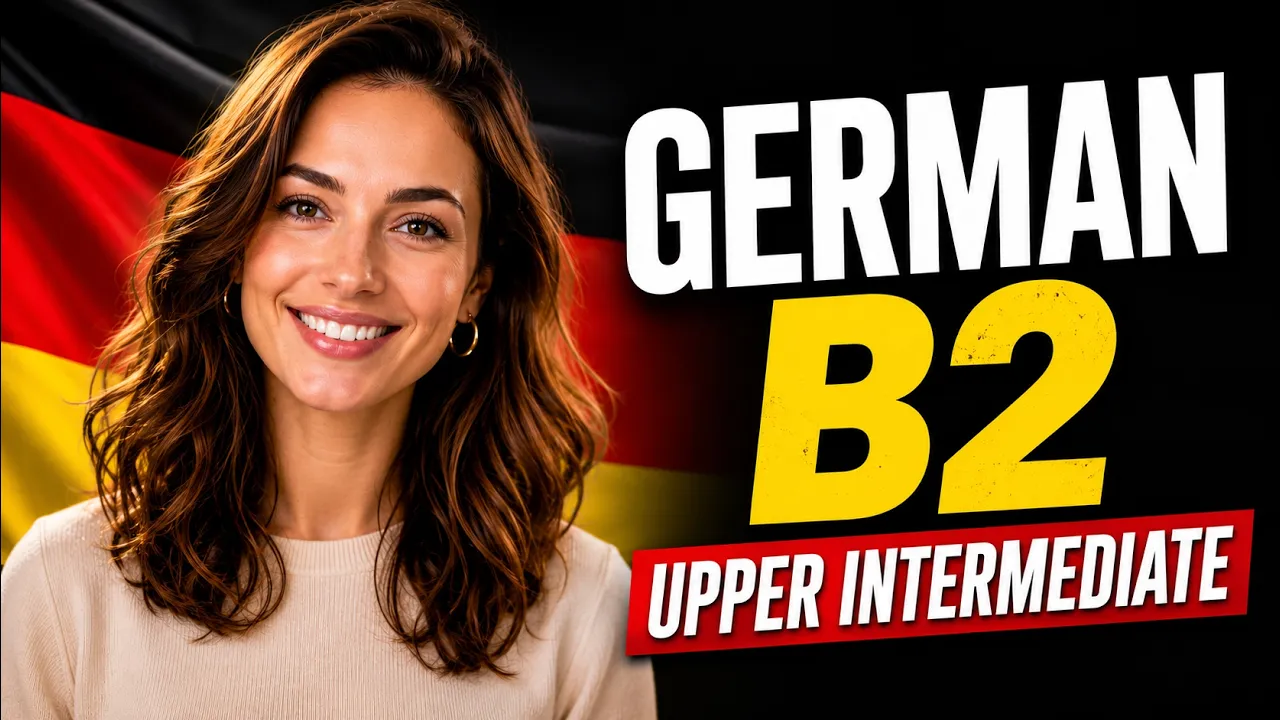
Master German B2: Upper Intermediate Course Guide
German B2 is the level where your language becomes more flexible, precise and natural. You are no longer only learning how to survive in everyday situations. You are learning how to explain complex ideas, understand longer texts, express opinions clearly and use more advanced grammar with confidence.
This guide is based on an upper-intermediate German course taught by a native German teacher. It brings together the most important B2 learning areas from the course: advanced tenses, nominalization, adjective-preposition combinations, modal connectors, cultural vocabulary, French-origin cognates and memory techniques.
If you prefer learning visually, watch the lesson below first. Then continue with the structured explanations, examples and practice tasks.
Video lesson: German B2 upper-intermediate course with grammar, culture and vocabulary practice.
What You Should Be Able to Do at German B2
At B2 level, you should be able to communicate more independently and accurately. You can understand many complex texts, discuss familiar and unfamiliar topics, explain advantages and disadvantages, and use German in work, study and everyday life.
The main difference between B1 and B2 is precision. At B1, you can communicate. At B2, you begin to communicate with more detail, structure and nuance.
- You can explain opinions clearly.
- You can understand longer spoken and written German.
- You can use more advanced connectors.
- You can describe causes, methods, alternatives and results.
- You can write more formal and structured texts.
- You can understand more cultural and abstract topics.
B2 goal: Do not only learn more German. Learn how to organize your German more precisely.
Futur II: Talking About the Completed Future and Past Assumptions
The Futur II is an advanced German tense. It is used in two important ways: to talk about something that will be completed in the future, and to express an assumption about something in the past.
How to Form Futur II
The structure is:
werden + Partizip II + haben/sein
| Function | Example | Meaning |
|---|---|---|
| Completed future | Bis morgen werde ich die Aufgabe gemacht haben. | By tomorrow, I will have done the task. |
| Past assumption | Er wird den Zug verpasst haben. | He probably missed the train. |
Futur II for the Completed Future
Use Futur II when an action will be finished before a future point in time.
- Bis nächstes Jahr wird er die Prüfung bestanden haben.
- Morgen Nachmittag werden wir den LKW repariert haben.
- Im Mai werdet ihr nach Deutschland gezogen sein.
Futur II for Past Assumptions
German also uses Futur II to make assumptions about the past. You are not completely sure, but you think something probably happened.
- Der Anwalt wird alle Beweise gekannt haben.
- Sein Stiefvater wird ihn adoptiert haben.
- Die Touristen werden schon einmal auf dieser Insel gewesen sein.
Notice that verbs of movement or change of state often use sein, just as in the perfect tense: gezogen sein, gewesen sein.
Nominalization: Turning Actions into Nouns
German often turns actions into nouns. This is called Nominalisierung. At B2 level, nominalization becomes important because it makes your German more flexible and more formal.
Many nominalized actions use the article das because the activity becomes a neuter noun.
| Original Expression | Nominalized Form | Example |
|---|---|---|
| mit dem Kopf nicken | das Kopfnicken | Das Kopfnicken bedeutet Zustimmung. |
| mit den Fingern schnipsen | das Fingerschnipsen | Das Fingerschnipsen ist nicht immer höflich. |
| rückwärts laufen | das Rückwärtslaufen | Das Rückwärtslaufen ist für Kinder am Anfang schwierig. |
| miteinander lachen | das Miteinanderlachen | Das Miteinanderlachen stärkt Beziehungen. |
Memory tip: When you turn an activity into a noun, capitalize it: laufen becomes das Laufen.
This structure is useful in formal writing because it allows you to talk about activities as concepts.
Adjectives with Prepositions
At B2 level, it is not enough to know an adjective alone. You also need to know which preposition usually follows it. These adjective-preposition combinations are fixed patterns.
Adjectives with Accusative Prepositions
| German Pattern | Meaning | Example |
|---|---|---|
| angewiesen auf + Akkusativ | dependent on | Babys sind auf ihre Eltern angewiesen. |
| bekannt für + Akkusativ | known for | Michael Jackson war für sein Talent bekannt. |
| böse auf + Akkusativ | angry with | Andrea ist böse auf ihre Freundin. |
| froh über + Akkusativ | happy about | Ich bin froh über den Abschluss des Projekts. |
| gespannt auf + Akkusativ | excited about / curious about | Wir sind gespannt auf den zweiten Teil des Buches. |
| stolz auf + Akkusativ | proud of | Frau Schmidt ist stolz auf ihre Schüler. |
| verliebt in + Akkusativ | in love with | Benjamin ist in seine Klassenkameradin verliebt. |
Adjectives with Dative Prepositions
| German Pattern | Meaning | Example |
|---|---|---|
| abhängig von + Dativ | dependent on | Die Wirtschaft ist vom Export abhängig. |
| begeistert von + Dativ | enthusiastic about | Die Zuschauer waren von der Vorstellung begeistert. |
| einverstanden mit + Dativ | in agreement with | Der Abteilungsleiter ist mit der Entscheidung einverstanden. |
| enttäuscht von + Dativ | disappointed by | Patrick ist von seinen Noten enttäuscht. |
| gut in + Dativ | good at | Melanie ist gut in Mathematik. |
| reich an + Dativ | rich in | Angola ist reich an Bodenschätzen. |
| verrückt nach + Dativ | crazy about | Viele Kinder sind verrückt nach Süßigkeiten. |
The best way to learn these combinations is not to memorize the adjective alone. Learn the full phrase: stolz auf, abhängig von, einverstanden mit.
German Culture and Vocabulary: Cities, Holidays and Food
A strong B2 course does not only teach grammar. It also gives you cultural knowledge and practical vocabulary. Culture topics help you understand texts, conversations and everyday references in German-speaking countries.
German Cities: Kiel and Augsburg
Kiel is a northern German city connected with the Baltic Sea, ships, sailing and maritime culture. It is also known for the Kieler Woche, a major summer festival with concerts, theater, fireworks, food stands and water sports.
Augsburg is a very old city in Bavaria. It is known for its historical city center, Christmas market, the Augsburger Puppenkiste and traditional southern German architecture.
German Holidays: St. Martin and Nikolaus
St. Martinstag is celebrated on November 11. Children often make lanterns and walk together while singing traditional songs.
Nikolaustag is celebrated on December 6. Children often find sweets or small gifts in a shoe placed near the door.
German Food Vocabulary
| German Dish | Type | Description |
|---|---|---|
| der Heringsalat | starter | A herring salad often served with onions, apples or potatoes. |
| das Hühnerfrikassee | main course | A chicken dish with sauce, vegetables, mushrooms and rice. |
| der Sauerbraten | main course | A traditional sour roast, often served with potatoes or dumplings. |
| die Dampfnudeln | dessert | Steamed sweet dumplings often served with vanilla sauce. |
Modal Connectors: Explaining How Something Happens
German uses modal connectors to explain how something happens or by what means something is done. These structures are especially useful for B2 writing and formal speaking.
Nominal Modal Connectors
| Connector | Meaning | Example |
|---|---|---|
| durch + Akkusativ | through / by means of | Durch gemeinnützige Arbeit kann man seiner Nachbarschaft helfen. |
| ohne + Akkusativ | without | Der Passant läuft ohne Orientierung durch die Stadt. |
| statt + Genitiv | instead of | Statt eines Rasenmähers kaufte der Hausmeister eine Kettensäge. |
Verbal Modal Connectors
| Connector | Use | Example |
|---|---|---|
| dadurch, dass | by doing something / through the fact that | Ich lerne schneller, dadurch dass ich jeden Tag übe. |
| indem | by doing something | Ich verbessere mein Deutsch, indem ich regelmäßig spreche. |
| ohne dass | without something happening | Wir lösten den Konflikt, ohne dass wir uns gestritten haben. |
| ohne zu | without doing something | Er kam zum Meeting, ohne sich zu entschuldigen. |
| anstatt dass | instead of someone doing something | Wir sollten reden, anstatt dass wir alles in uns hineinfressen. |
| anstatt zu | instead of doing something | Man sollte frisch kochen, anstatt Essen aus Dosen zu essen. |
B2 writing tip: Connectors such as indem, ohne dass and anstatt zu make your German more structured and mature.
French-Origin Cognates in German
German contains many words of French origin. Many of them are useful at B2 level because they appear in academic, professional and cultural contexts.
Some examples include:
| German Word | English Meaning | Article |
|---|---|---|
| der Akzent | accent | der |
| das Baguette | baguette | das |
| die Chance | chance / opportunity | die |
| das Dessert | dessert | das |
| die Energie | energy | die |
| die Information | information | die |
| die Karriere | career | die |
| das Niveau | level | das |
| das Restaurant | restaurant | das |
| die Routine | routine | die |
These cognates help you expand your vocabulary quickly, but do not forget to learn the article and pronunciation together with the word.
Eselsbrücken: Memory Techniques for German
An Eselsbrücke is a memory aid. It can be a rhyme, image, association or funny sentence that helps you remember a word or rule.
At B2, you still need memory techniques because the amount of vocabulary and grammar increases. Eselsbrücken make difficult words easier to remember.
Examples of German Memory Aids
- Substantive schreibt man groß. — German nouns are capitalized.
- Wer nämlich mit h schreibt, ist dämlich. — Helps learners remember that nämlich has no h.
- Die kurze Gasse, die lange Straße. — Helps remember short vowel before ss and long vowel before ß.
Create Your Own Eselsbrücken
You can connect German words with English or visual images:
- bewundern — to admire: The soldiers admire the admiral.
- geduldig — patient: The patient waits patiently.
- das Auge — eye: Imagine an eye on an egg.
The more personal or visual the memory aid is, the easier it is to remember.
Common B2 Mistakes
Mistake 1: Learning Advanced Grammar Without Using It
It is not enough to recognize Futur II or modal connectors in exercises. You need to use them in your own sentences.
Mistake 2: Memorizing Adjectives Without Prepositions
Do not learn only stolz. Learn stolz auf + Akkusativ. Do not learn only abhängig. Learn abhängig von + Dativ.
Mistake 3: Avoiding Formal German
B2 requires stronger writing and more formal structures. Practice nominalization and connectors because they appear often in written German.
Mistake 4: Ignoring Culture
Language and culture belong together. Cultural topics such as holidays, cities, food and social traditions help you understand real German better.
Practice: German B2 Exercises
Exercise 1: Complete the Futur II
- Bis morgen werde ich die E-Mail __________ __________. (schreiben)
- Nächstes Jahr wird sie nach Deutschland __________ __________. (ziehen)
- Er wird den Termin sicher __________ __________. (vergessen)
Exercise 2: Choose the Correct Preposition
- Ich bin stolz ___ meine Fortschritte.
- Sie ist enttäuscht ___ dem Ergebnis.
- Er ist gut ___ Mathematik.
- Wir sind gespannt ___ den neuen Kurs.
Exercise 3: Use a Modal Connector
Complete the sentences with indem, ohne dass, anstatt zu or dadurch, dass.
- Ich lerne Vokabeln schneller, ___ ich Eselsbrücken benutze.
- Er ging nach Hause, ___ sich zu verabschieden.
- Wir lösten das Problem, ___ wir ruhig miteinander sprachen.
- Sie bestand die Prüfung, ___ sie einen Sprachkurs besuchte.
Answer Key
- Bis morgen werde ich die E-Mail geschrieben haben.
- Nächstes Jahr wird sie nach Deutschland gezogen sein.
- Er wird den Termin sicher vergessen haben.
Prepositions:
- stolz auf meine Fortschritte
- enttäuscht von dem Ergebnis
- gut in Mathematik
- gespannt auf den neuen Kurs
Modal connectors:
- indem
- ohne sich zu verabschieden
- indem / dadurch, dass
- dadurch, dass
How to Study German B2 Effectively
At B2, passive learning is not enough. You need to transform grammar and vocabulary into active language.
- Choose one grammar topic at a time.
- Read several examples before memorizing the rule.
- Create your own sentences with the structure.
- Use advanced connectors in short written texts.
- Record yourself explaining a topic in German.
- Review adjective-preposition combinations regularly.
- Use Eselsbrücken for difficult vocabulary.
If you need to review earlier foundations, the free German workbook for beginners can help strengthen basic sentence patterns and grammar.
If you want a full A1–C2 learning path, the LangAdvance German Membership gives you access to structured courses, including higher-level German lessons.
For learners who prefer lifetime access, the Complete German Learning System can support long-term German development across grammar, vocabulary, listening and speaking.
Final Review: Your German B2 Learning Path
German B2 is the level where your language becomes more precise, flexible and expressive. You learn to use advanced grammar not as theory, but as a tool for clearer communication.
Focus on structures that help you speak and write better: Futur II, Nominalisierung, adjective-preposition combinations, modal connectors and memory techniques.
Keep practicing actively. At B2, progress comes from using German in longer explanations, structured writing, real conversation and cultural contexts.
Steps tested on the current version at the time of writing. If a screen or setting has moved, email us and we update the tutorial. Results depend on your offer and your market; nothing here is a promise of income.