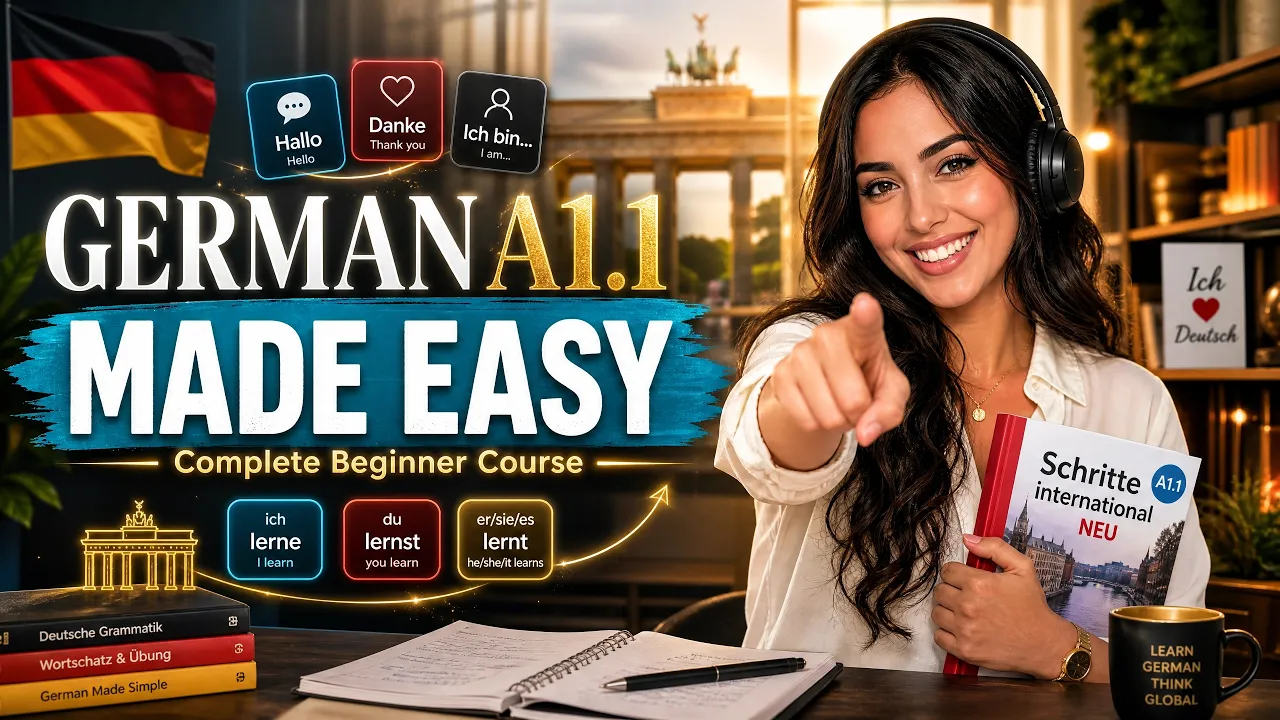
German A1.1 Made Easy: Complete Beginner Course
German A1.1 is the first step in building real German sentences. At this level, your goal is not to learn complicated grammar. Your goal is to understand simple sentence patterns and repeat them until they become automatic.
This course uses a practical translation and repetition method. You learn a new word, see it inside a sentence, repeat it many times and slowly build the ability to speak without translating every word in your head.
In this guide, you will practice essential beginner verbs, simple pronouns, negation, basic word order, useful adverbs, and the first article patterns with ein, einen and eine.
Video lesson: German A1.1 beginner course with sentence drills and speaking practice.
What You Learn in German A1.1
A1.1 is the first half of the beginner level. It introduces you to the most important sentence structures you need for simple communication.
In this course, you practice:
- basic German verbs,
- simple sentences with ich, wir and sie,
- speaking about languages, work, study and life,
- negation with nicht,
- basic adverbs such as hier, dort, jetzt and jeden Tag,
- common nouns such as car, house, hotel, problem, man, woman and family,
- the difference between ein, einen and eine,
- short speaking drills that help you respond faster.
Beginner principle: Learn complete sentences, not only single words. Complete sentences are easier to use in real conversation.
Essential German Verbs for A1.1
The course begins with high-frequency verbs that help you create many useful sentences quickly.
| German Verb | English Meaning | Example Sentence |
|---|---|---|
| lieben | to love | Ich liebe Deutsch. |
| sprechen | to speak | Ich spreche Deutsch. |
| sehen | to see | Ich sehe es. |
| studieren | to study | Ich studiere in Deutschland. |
| arbeiten | to work | Ich arbeite hier. |
| lernen | to learn | Ich lerne Deutsch online. |
| leben | to live | Ich lebe in Deutschland. |
| verstehen | to understand | Ich verstehe Deutsch. |
| helfen | to help | Sie helfen mir. |
| machen | to do / to make | Ich mache es jeden Tag. |
| haben | to have | Ich habe ein Auto. |
These verbs are useful because they allow you to talk about yourself immediately: what you love, what you speak, what you learn, where you live and what you have.
Start with “Ich”: Simple Sentences About Yourself
The pronoun ich means “I.” At A1.1, many beginner sentences start with ich because learners first need to talk about themselves.
| German Sentence | English Meaning | Pattern |
|---|---|---|
| Ich liebe dich. | I love you. | Ich + verb + object |
| Ich spreche Deutsch. | I speak German. | Ich + spreche + language |
| Ich spreche Englisch und Deutsch. | I speak English and German. | Ich + spreche + language + und + language |
| Ich sehe es jetzt. | I see it now. | Ich + sehe + object + time |
| Ich arbeite hier. | I work here. | Ich + arbeite + place |
| Ich lebe in Deutschland. | I live in Germany. | Ich + lebe + in + place |
| Ich lerne Deutsch online. | I learn German online. | Ich + lerne + language + method/place |
Practice these sentences aloud. Do not only read them silently. Speaking practice trains your mouth and memory at the same time.
Talking About Languages in German
One of the most useful beginner topics is language. You can quickly say which languages you speak, learn or understand.
Language Vocabulary
| German | English |
|---|---|
| Deutsch | German |
| Englisch | English |
| Russisch | Russian |
| Spanisch | Spanish |
| Italienisch | Italian |
Useful Sentences
- Ich spreche Deutsch. — I speak German.
- Ich spreche Englisch. — I speak English.
- Ich spreche Deutsch und Englisch. — I speak German and English.
- Ich spreche Deutsch, Englisch und Russisch. — I speak German, English and Russian.
- Ich lerne Deutsch online. — I learn German online.
- Ich verstehe Deutsch. — I understand German.
Important Small Words: Hier, Dort, Jetzt and Jeden Tag
Small words help you add more detail to simple German sentences.
| German | English | Example |
|---|---|---|
| hier | here | Ich arbeite hier. |
| dort | there | Ich lebe dort. |
| jetzt | now | Ich sehe es jetzt. |
| online | online | Ich lerne Deutsch online. |
| jeden Tag | every day | Ich mache es jeden Tag. |
| sehr gut | very well | Ich verstehe dich sehr gut. |
These words make your sentences more natural. Compare:
- Ich arbeite. — I work.
- Ich arbeite hier. — I work here.
- Ich arbeite jeden Tag. — I work every day.
Negation with Nicht
The word nicht means “not.” It is one of the first words beginners need because it helps you create negative sentences.
| Positive Sentence | Negative Sentence | Meaning |
|---|---|---|
| Ich verstehe. | Ich verstehe nicht. | I do not understand. |
| Ich arbeite. | Ich arbeite nicht. | I do not work. |
| Ich studiere. | Ich studiere nicht. | I do not study. |
| Ich sehe. | Ich sehe nicht. | I do not see. |
Begin with short negative sentences. Then combine them with positive sentences:
- Ich arbeite nicht. Ich studiere.
- Ich studiere nicht. Ich arbeite.
- Wir verstehen nicht.
Using Wir and Sie
After practicing ich, the course moves to other common pronouns such as wir and sie.
| Pronoun | Meaning | Example |
|---|---|---|
| ich | I | Ich verstehe Deutsch. |
| wir | we | Wir sprechen Deutsch. |
| sie | they | Sie machen es jeden Tag. |
Examples with Wir
- Wir verstehen dich. — We understand you.
- Wir verstehen dich sehr gut. — We understand you very well.
- Wir sehen es jetzt. — We see it now.
- Wir sprechen Deutsch. — We speak German.
- Wir lernen Deutsch und Englisch online. — We learn German and English online.
Examples with Sie
- Sie helfen mir. — They help me.
- Sie machen es jeden Tag. — They do it every day.
- Sie verstehen dich. — They understand you.
- Sie sehen mich. — They see me.
- Sie sprechen Italienisch. — They speak Italian.
Object Pronouns: Dich, Mich, Mir and Es
German pronouns change depending on their role in the sentence. At A1.1, you can start by learning useful fixed patterns.
| German | English | Example |
|---|---|---|
| dich | you | Ich sehe dich. |
| mich | me | Sie verstehen mich. |
| mir | me / to me | Sie helfen mir. |
| es | it | Ich sehe es. |
Useful sentence patterns:
- Ich sehe dich. — I see you.
- Ich verstehe dich. — I understand you.
- Ich verstehe dich sehr gut. — I understand you very well.
- Sie sehen mich. — They see me.
- Sie helfen mir jeden Tag. — They help me every day.
Using Haben: Talking About What You Have
The verb haben means “to have.” It is one of the most important beginner verbs because it helps you talk about objects, family and problems.
| German Sentence | English Meaning | Key Pattern |
|---|---|---|
| Ich habe ein Auto. | I have a car. | haben + ein + neuter noun |
| Ich habe ein Haus. | I have a house. | haben + ein + neuter noun |
| Ich habe ein Problem. | I have a problem. | haben + ein + neuter noun |
| Ich habe einen Bruder. | I have a brother. | haben + einen + masculine noun |
| Ich habe eine Schwester. | I have a sister. | haben + eine + feminine noun |
| Ich habe eine Frage. | I have a question. | haben + eine + feminine noun |
| Ich habe eine Familie. | I have a family. | haben + eine + feminine noun |
Ein, Einen and Eine: First Article Patterns
German articles change depending on gender and case. At A1.1, a useful first step is learning common patterns after verbs like haben and sehen.
Use Ein with Neuter Nouns
| German | English |
|---|---|
| ein Auto | a car |
| ein Haus | a house |
| ein Hotel | a hotel |
| ein Problem | a problem |
Use Einen with Masculine Direct Objects
| German | English |
|---|---|
| einen Mann | a man / one man |
| einen Bruder | a brother |
| einen Plan | a plan |
| meinen Vater | my father |
Use Eine with Feminine Nouns
| German | English |
|---|---|
| eine Frau | a woman |
| eine Idee | an idea |
| eine Frage | a question |
| eine Familie | a family |
| eine Schwester | a sister |
A1.1 shortcut: Memorize article patterns inside full phrases: ein Auto, einen Bruder, eine Frage.
Family Vocabulary in Simple Sentences
Family words appear often in beginner German. They are also useful for practicing articles and possessive forms.
| German Sentence | English Meaning |
|---|---|
| Ich habe einen Bruder. | I have a brother. |
| Ich habe eine Schwester. | I have a sister. |
| Ich habe einen Bruder und eine Schwester. | I have a brother and a sister. |
| Ich liebe meine Familie. | I love my family. |
| Ich liebe meine Mutter. | I love my mother. |
| Ich liebe meinen Vater. | I love my father. |
| Ich liebe meinen Bruder. | I love my brother. |
| Ich liebe meine Schwester. | I love my sister. |
Notice the difference between meine Mutter and meinen Vater. This is an early sign of German case and gender changes.
Plural Practice: Numbers with Nouns
The course also introduces simple plural patterns with numbers.
| German | English |
|---|---|
| zwei Autos | two cars |
| drei Autos | three cars |
| zwei Probleme | two problems |
| zwei Fragen | two questions |
| drei Fragen | three questions |
Example sentences:
- Ich sehe zwei Autos. — I see two cars.
- Ich sehe drei Autos. — I see three cars.
- Ich habe zwei Probleme. — I have two problems.
- Wir haben drei Fragen. — We have three questions.
Core Sentence Patterns to Memorize
At A1.1, sentence patterns are more important than long grammar explanations. Memorize these patterns and replace one word at a time.
| Pattern | Example | Replace With |
|---|---|---|
| Ich spreche … | Ich spreche Deutsch. | Englisch, Russisch, Spanisch |
| Ich lerne … online. | Ich lerne Deutsch online. | Englisch, Deutsch und Englisch |
| Ich lebe in … | Ich lebe in Deutschland. | Russland, Moskau |
| Ich arbeite … | Ich arbeite hier. | dort, in Deutschland, in Russland |
| Ich sehe … | Ich sehe dich. | es, einen Mann, eine Frau, ein Auto |
| Ich habe … | Ich habe eine Frage. | ein Auto, einen Bruder, eine Idee |
Common Beginner Mistakes
Mistake 1: Learning Verbs Without Sentences
Do not only learn sprechen = to speak. Learn Ich spreche Deutsch. This helps you speak faster.
Mistake 2: Ignoring Article Changes
German does not always use the same word for “a.” You need to learn ein Auto, einen Bruder and eine Schwester.
Mistake 3: Practicing Only in Your Head
This type of course works best when you speak aloud. Repetition trains pronunciation and automatic recall.
Mistake 4: Forgetting Nicht
Use nicht to make simple negative sentences: Ich verstehe nicht, Ich arbeite nicht, Wir verstehen nicht.
Mistake 5: Learning Too Many Words Without Repetition
A1.1 is about strong foundations. It is better to repeat 30 useful sentences many times than to memorize 300 words you cannot use.
Practice Exercises
Exercise 1: Translate into German
- I speak German.
- I speak English and German.
- I love Germany.
- I work here.
- I live in Germany.
- I understand you very well.
- We speak German.
- They help me every day.
Exercise 2: Complete with Nicht
- Ich verstehe __________.
- Ich arbeite __________.
- Ich studiere __________.
- Wir verstehen __________.
Exercise 3: Choose Ein, Einen or Eine
- Ich habe __________ Auto.
- Ich sehe __________ Mann.
- Ich habe __________ Schwester.
- Ich habe __________ Frage.
- Wir haben __________ Plan.
- Ich sehe __________ Frau.
- Ich habe __________ Problem.
- Ich sehe __________ Hotel.
Exercise 4: Build Your Own Sentences
Use the patterns below and create your own sentences:
- Ich spreche …
- Ich lerne … online.
- Ich lebe in …
- Ich habe …
- Ich sehe …
Answer Key
- Ich spreche Deutsch.
- Ich spreche Englisch und Deutsch.
- Ich liebe Deutschland.
- Ich arbeite hier.
- Ich lebe in Deutschland.
- Ich verstehe dich sehr gut.
- Wir sprechen Deutsch.
- Sie helfen mir jeden Tag.
Negation:
- Ich verstehe nicht.
- Ich arbeite nicht.
- Ich studiere nicht.
- Wir verstehen nicht.
Articles:
- Ich habe ein Auto.
- Ich sehe einen Mann.
- Ich habe eine Schwester.
- Ich habe eine Frage.
- Wir haben einen Plan.
- Ich sehe eine Frau.
- Ich habe ein Problem.
- Ich sehe ein Hotel.
How to Study This A1.1 Course Effectively
This course is based on repetition and sentence drilling. To get the best result, practice actively.
- Listen to a sentence.
- Repeat it aloud.
- Translate it from English to German.
- Repeat the German sentence again.
- Change one word and create a new sentence.
- Review old sentences before learning new ones.
- Record yourself once per week to check your pronunciation.
For extra beginner support, use the free German workbook for beginners to reinforce vocabulary, sentence patterns and basic grammar.
If you want a complete learning path from A1 to C2, the LangAdvance German Membership gives you access to structured German courses and regular practice.
For learners who prefer lifetime access to one complete study package, the Complete German Learning System can support long-term grammar, vocabulary, listening and speaking development.
Final Review: German A1.1 Made Easy
German A1.1 becomes easier when you focus on practical sentence patterns. Start with simple verbs such as sprechen, lieben, sehen, arbeiten, lernen, leben, verstehen and haben.
Practice short sentences until they become automatic: Ich spreche Deutsch, Ich arbeite hier, Ich verstehe dich, Ich habe eine Frage.
The more you repeat, the faster German starts to feel natural. Keep your sentences simple, speak aloud and build your A1.1 foundation step by step.
Steps tested on the current version at the time of writing. If a screen or setting has moved, email us and we update the tutorial. Results depend on your offer and your market; nothing here is a promise of income.